Category Archives: San Antonio Business Lawye

Top Exit Planning Strategies for Small Business Owners

Small Business Owners:  Listen to this thought. You’ve poured your heart and soul into building your company, but have you thought about your exit strategy? If not, you’re making a huge mistake that could cost you millions. Don’t worry, I’m here to help you avoid that costly blunder.

The Cold, Hard Truth About Small Business Exit Strategies

Look, I get it. You’re busy running your business day-to-day. The last thing on your mind is how you’re going to leave it someday. But here’s the reality: without a solid exit plan, you’re gambling with your financial future1.

Think about it. You wouldn’t start a cross-country road trip without a map, would you? So why are you running your business without an exit strategy? It’s time to wise up and start planning your escape route.

The Million-Dollar Secret to Successful Exit Planning

By the way, did you know that business owners who plan their exit strategies in advance can increase the value of their businesses by up to 50%?2 That’s right, you could be leaving millions on the table by not planning ahead.

But don’t panic. I’m about to share with you the top exit planning strategies that will have buyers lining up to throw money at you when you’re ready to sell. Are you ready? Let’s dive in.

Strategy #1: Start Early and Often

Listen closely, because this is crucial. The best time to start planning your exit is the day you open your business. The second-best time? Right now.

Don’t make the mistake of waiting until you’re ready to retire. By then, it’s too late. You need to be working on your exit strategy constantly, tweaking and refining it as your business grows and changes3.

Strategy #2: Know Your Numbers Cold

You see, when it comes time to sell, potential buyers are going to scrutinize every aspect of your financials. If you can’t explain every single number, you’re dead in the water.

Start keeping meticulous records now. Know your profit margins, your growth rate, your customer acquisition costs. These numbers will be your secret weapon when it’s time to negotiate.

Strategy #3: Build a Business That Can Run Without You

Think about it. Would you want to buy a business that falls apart the moment the owner walks away? Of course not. Neither do your potential buyers.

Start delegating. Build strong systems and processes. Train your team to run the show without you. This not only makes your business more valuable, but it also gives you the freedom to start planning your next adventure.

Strategy #4: Diversify Your Customer Base

Look, having a few big clients might seem great now, but it’s a ticking time bomb when it comes to selling your business. Buyers want to see a diverse customer base that can weather the loss of any single client.

Start expanding your client roster today. It might be more work now, but it’ll pay off big time when you’re ready to cash out.

Strategy #5: Clean Up Your Act

By the way, did you know that legal issues are one of the biggest deal-killers in small business sales? It’s true. Even minor legal hiccups can send potential buyers running for the hills.

So, get your house in order. Resolve any outstanding legal issues. Make sure all your contracts are up to date. Dot your i’s and cross your t’s. It might seem tedious now, but it’ll be worth it when you’re counting your millions later.

The Million-Dollar Takeaway

Remember, planning your exit strategy isn’t just about selling your business. It’s about maximizing the value of all your hard work. It’s about securing your financial future. It’s about leaving a legacy.

So, what are you waiting for? Start implementing these small business exit strategies today. Your future self will thank you when you’re sipping margaritas on a beach, counting the millions you made from your perfectly executed exit plan.

And that’s all there is to it. Now get to work on your exit strategy. Your financial future depends on it.

Are You Leaving Millions on the Table?

Discover The 7-Figure Exit Accelerator

Debt Financing for Businesses: A Simple Guide for Smart Growth

What is debt financing?

  • Companies, just like people, sometimes need extra money to buy cool stuff or do big projects.
  • Instead of saving up for ages, they can borrow money (called “debt”) and promise to pay it back later, plus a little extra (that’s the “interest”).
  • This is way faster than saving for everything, and helps companies grow!

Types of Debt Financing

  1. Bank Loans:
  • This is the classic “go to the bank” option.
  • The bank gives you a set amount of money, and you pay it back in regular payments (like your allowance, but bigger chunks).
  • Example: A bakery needs $20,000 for a new oven. They get a bank loan and pay it back over five years.


2.  SBA Loans:

  • These loans are like bank loans, but the “SBA” (Small Business Administration) helps make them happen.
  • The government says, “Hey bank, lend to this smaller company, and we’ll make it less risky for you.”
  • It’s great for new or smaller businesses that might have trouble getting a traditional loan on their own.

SBA 7(a) Loans

  • The most popular SBA loan: This is great for all sorts of business needs.
  • Max Amount: Up to $5 million
  • Examples of Use:
    • Buying equipment or machinery
    • Buying land or buildings
    • Hiring more people
    • Refinancing existing business debt

SBA 504 Loans

  • Focused on big stuff: These loans are for major fixed assets like fancy machinery or buying a whole building.
  • Max Amount: Up to $5 million (up to $5.5 million for certain energy-efficient projects or manufacturing).
  • Example of Use: A factory needs to buy a huge, expensive machine to make more products.

SBA Microloans

  • Helping smaller businesses get off the ground: These loans are for startups or businesses needing just a bit of extra cash.
  • Max Amount: Up to $50,000
  • Examples of Use:
    • Buying supplies and inventory
    • Renting a small workspace
    • Marketing your new business

3.  Mezzanine Debt

Hybrid Nature:

  • Mezzanine debt is like a blend of regular debt (bank loans) and equity (ownership in the company).
  • Lenders give the company money, but they also get something called “warrants.”
  • Warrants are the right to buy shares in the company at a set price later on. This makes it potentially more rewarding for the lender if the company does well.

Position in the Company’s Finances:

  • “Mezzanine” means “middle” – this debt sits in the middle of a company’s capital structure:
    • Senior Debt: Traditional loans from banks are on top. They get paid back first if something bad happens.
    • Mezzanine Debt: Sits below senior debt – riskier for the lender.
    • Equity: The owners’ stake in the company is at the bottom.

Why Companies Use It:

  • Growth: Companies that are growing quickly but don’t want to sell a big chunk of ownership may like this option.
  • Flexibility: Mezzanine debt can have more flexible repayment terms than traditional loans.
  • When banks get nervous: If a company is considered a bit riskier, traditional lenders might shy away. Mezzanine lenders are more open to risk in exchange for potential rewards.

The Downside:

  • Expensive: Mezzanine debt usually has higher interest rates than bank loans because the lenders take on more risk.
  • Potential Dilution: Those “warrants” the lenders get could mean existing owners have a smaller share of the company if the warrants are exercised.

Example: A hot new app company needs a ton of cash to make their app even better. Mezzanine debt lets them do that.

Other Types of Debt:

  1. Bonds:
  • Companies basically sell ‘IOUs’ to a bunch of investors.
  • Investors give money now, company pays it back later (plus interest).
  • Example: A big car maker might need billions to build a new factory. They issue bonds to get that money.
  1. Lines of Credit
  • Think of it like a company credit card.
  • The lender says, “You can borrow up to X amount whenever you need it.”
  • Great for unexpected expenses or when cash flow is up and down.
  • Example: A construction company gets busy sometimes and slow other times. They have a line of credit to make sure they can pay workers.

Important Things to Remember

  • Debt is NOT free money! You gotta pay it back, plus that extra “interest.”
  • Companies have to be careful not to borrow too much or they might not be able to make the payments.
  • Just like you choose your friends carefully, companies must pick the right type of debt for what they need!

GREAT EXPECTATION PRECEDES GREAT ACHIEVEMENT

GREAT EXPECTATION PRECEDES GREAT SUCCESS

High expectation always precedes high achievement. You’re as small as your controlling desires, or as great as your dominant aspirations.

Once your mind stretches to a new idea it never goes back to its original dimensions.

Think little goals and you can expect little achievement. Think big goals and you’ll win big success. The first ingredient of your success is to dream a great dream.

You must dream big and think big to be big.

The Visionary Power of Big Dreams

The human mind is a remarkable tool, capable of conjuring and manifesting extraordinary possibilities. When we dare to dream big, we unlock the potential that lies dormant within us. Great achievements throughout history have been born from audacious visions – from the Wright brothers’ dream of flight to Elon Musk’s ambition to colonize Mars.

Consider the story of J.K. Rowling, who envisioned a world of magic and wizardry while struggling as a single mother on welfare. Her unwavering belief in her creation led to the Harry Potter series, a global phenomenon that transformed her life and captivated millions worldwide.

The Psychology of Achievement: Self-Fulfilling Prophecies

Our expectations have a profound impact on our actions and outcomes. When we set high expectations for ourselves, we create a self-fulfilling prophecy. We become more focused, motivated, and resilient, pushing our limits to reach our desired goals. Conversely, limiting beliefs can hold us back, causing us to self-sabotage and settle for mediocrity.

Research in psychology has repeatedly demonstrated the power of positive expectations. The Pygmalion effect, for instance, shows that when teachers believe in their students’ potential, those students tend to perform better. This principle applies to all areas of life – when we believe in ourselves and our abilities, we are more likely to succeed.

Visualization: A Blueprint for Success

Visualization is a powerful technique that can help us turn our dreams into reality. By creating a mental picture of our desired outcomes, we activate the same neural pathways as if we were actually experiencing them. This process primes our minds for success, making us more likely to take the necessary actions to achieve our goals.

Olympic athletes often use visualization to enhance their performance. They imagine themselves executing their routines flawlessly, winning medals, and standing on the podium. This mental rehearsal helps them develop muscle memory, improve focus, and overcome anxiety, ultimately leading to better results.

Embracing Challenges: Growth Through Adversity

The path to greatness is rarely smooth. Challenges and setbacks are inevitable, but they can also be our greatest teachers. When we view obstacles as opportunities for growth, we transform them from roadblocks into stepping stones. Each hurdle we overcome strengthens our resolve and brings us closer to our goals.

Consider the story of Thomas Edison, who famously said, “I have not failed. I’ve just found 10,000 ways that won’t work.” Edison’s relentless pursuit of the incandescent light bulb, despite numerous setbacks, is a testament to the power of perseverance and the importance of learning from mistakes.

The Power of Persistence: Never Giving Up

Persistence is the key to unlocking our full potential. When we refuse to give up on our dreams, we create the conditions for success. By maintaining a steadfast focus on our goals and taking consistent action, we increase our chances of achieving them, no matter how long it takes.

The story of Colonel Sanders, the founder of Kentucky Fried Chicken, exemplifies the power of persistence. He faced countless rejections before finding a restaurant willing to serve his signature fried chicken recipe. His unwavering belief in his product and his determination to succeed eventually led to the creation of a global fast-food empire.

Self-Belief: The Foundation of Success

True success starts with self-belief. When we believe in ourselves and our abilities, we unlock our inner potential and create the conditions for extraordinary achievements. Self-belief is a powerful force that can propel us forward, even in the face of adversity.

The life of Oprah Winfrey is a testament to the power of self-belief. She overcame a difficult childhood and numerous obstacles to become one of the most successful and influential women in the world. Her unwavering faith in herself and her abilities allowed her to break barriers and achieve her dreams.

Inspiring Others: The Ripple Effect of Success

As we strive for greatness, we have the power to inspire and uplift others. Our actions, our words, and our achievements can create a ripple effect that extends far beyond our own lives. By sharing our stories, our struggles, and our triumphs, we can ignite the spark of ambition in others and empower them to pursue their own dreams.

Conclusion

The journey to success is a continuous process of growth, learning, and self-discovery. By setting high expectations, embracing challenges, persisting in the face of adversity, and believing in ourselves, we can achieve our wildest dreams and inspire others to do the same. Remember, the only limits we have are the ones we place on ourselves. So, dream big, think big, and dare to be great.

Escaping The Corporate Cubicle

Escaping The Corporate Cubicle

Have you ever felt like you were trapped?

Trapped in the corporate cubicle…trapped in a job you may not enjoy…trapped doing something that consumes your life and is not getting you to your goals?

One of our mentors shared this story recently….

“I worked in corporate consulting in a forty-five story office building in New York City. I thought I had it made. I worked 60 hours a week, got 15 days of vacation a year and had a nice manager title, nice benefits and great people I worked with…

…but I felt trapped. I felt like the goals I really wanted in life were slipping away as I worked my tail off each week in the cubicle.

I had an aha-moment the day I shared my dream with one of my corporate mentors, who patted me on the shoulder and said: ‘The only security you will ever have in life is what you create for yourself’.

Reflecting on his powerful comment as I walked back to my cubicle, I understood that to achieve what I wanted long term, I had to prepare and condition myself mentally and emotionally, toughen up my belief and confidence, and bullet-proof my vision with the right skill sets and action steps for this new business and life direction.”

So how do you escape the corporate cubicle?

It all starts with a desire like my mentor above.

Then it takes ACTION.

You actually have to make a plan to get yourself out of that Rat Race and follow up with it.

Here is a list of some of the things you should have on your “Action Plan”

  1. Find an opportunity or business that you are going to start. Do your research and make sure that it is something you will enjoy doing but not only that…something that actually makes money. Too many times people embark on opportunities because it sounds fun…but they soon find the financial rewards were not as great as they thought in the beginning.Look at other successful people in that opportunity and find out what they are doing and how much they are making and importantly what they had to do to get there. Not all opportunities are equal. Pick one that is growing and will give you the opportunity to rise up with it.
  2. Create a business plan. Put realistic goals and expectations. You are in this for the long run. With a good opportunity it may take you a few years or more to get to the point where you can quit that job forever…but realize when you do YOU ARE FREE! So make a long-term business plan. People who fail, usually don’t have a business plan and they think success should be instant.
  3. Fill your mind with POSITIVE information and teachings. Read Thank and Grow Rich and As a Man Thinketh. Listen to the teachings of Wayne Dyer, Tony Robbins, Jim Rohn, Zig Ziglar, Brian Tracy, Earl Nightengale, Denis Waitley, and Dale Carnegie to name a few. Let them become your coaches and mentors.
  4. TAKE MASSIVE ACTION! Decide what you want to do and GO FOR IT! Find the time in your life even if you are super busy. Work on your new business during your lunch hour, early in the morning, late at night. Find the time. You can do it because you know the rewards will be worth it.A few years of time sacrifice will be worth it when you break out of the cubicle and live a life of freedom!

It is very possible to reach your goals and escape the Rat Race if you really want it. Sure there will be bumps in the road and it may not always turn out exactly like you wanted and you may have to change courses a few time.

…but if you stay the course, work hard, and never quit… You will be rewarded.

Remember the day you walk away from your job and are carrying your box of personal items out to your car…not because you were fired or laid off…

…but because you QUIT!

(Don’t forget to have someone take pictures of you with your box of stuff as you walk to your car…it will be part of your story!)

If you are looking for a great opportunity that can help YOU escape the cubicle, watch the video below and see what I’m doing.

Watch This Video

…and follow the simple steps. It’s working for me and thousands of others out there online.

To your success,

Jim Montgomery

San Antonio Business Law

The Monkey Story – Developing Procedures

The Monkey Story

It seems that there was a research project in which the scientists used four monkeys, a ladder and a banana. They put the four monkeys in a room with the ladder and put the banana on top of the ladder.

As monkeys will, the first monkey smelled the banana and started up the ladder. When he got half way up, the scientists turned on a water cannon filled with ice cold water. The cannon knocked the first monkey off the ladder and then iced down the other three monkeys. The monkeys huddled in the room shivering from the cold bath.

After a while, once the monkeys had warmed up, a second monkey smelled the banana and started up the ladder. Again, the water cannon came on, knocked her off the ladder and iced down the other monkeys for good measure.

When the third monkey started to go up the ladder for the banana, the other three monkeys grabbed him and beat the “you know what” out of the errant monkey. The scientists were quite surprised to see that behavior. They decided to introduce a new element into the experiment.

One of the monkeys was removed from the room and replaced by a new monkey. Before long, the new monkey smelled the banana and headed up the ladder. Sure enough, the other three monkeys grabbed the new monkey pulled her down and beat the tar out of her.

The scientists again replaced one of the first group of monkeys and the scenario repeated itself. They kept replacing monkeys until all of the original monkeys who had been iced down were gone.

When the new monkey went for the banana, guess what happened?  That’s right, the rest of the monkeys taught the new monkey not to go for the banana!  And none of them knew why they did it any more!

Is this how procedures are developed at your business?

Need help?  Call us at 210-690-3700 for a free no obligation consultation.  Get twice as much for your business or fire yourself and keep the money coming.

Learn about the Obama Tax Increases

Are you ready to pay more taxes?
Here is the Obama Tax Plan (not to mention the Supreme Court’s disclosure of the Obamacare Tax Plan) announced 2 years ago:
  • It plans to increase individual tax rates to a 39.6% plus 3.8% which equals 43.4% annual tax rate.
  • Increase capital gains tax rates to 28% plus 3.8% = 31.8%
  • Dividends will be taxed at 39.6% plus 3.8% = 43.4%
  • Increase the amount of healthcare costs to individuals.
  • Reduce itemized deductions by 30%.

Read the rest of the article here.

San Antonio Business Attorney

San Antonio Business Lawyer  “After literally taking business transactions apart in the courtroom for years, clients (and opponents) began asking me to work on the transactions from the beginning to prevent the problems . . .”

San Antonio Business Attorney James Montgomery

Business owners and entrepreneurs choose to work with me because I guide them to solve problems and systematize their business in a relationship of respect, integrity and creativity.

What that means is that I focus you on what matters most to you, your family and your business to realize your dreams.

The benefit is the feeling you get from a sense of security and peace of mind from accomplishing your goals and protecting those for whom you care the most.

________________________________________________________

After buying and selling over $180 Million in businesses in the last five years, as a business owner, former banker, and business attorney, I have seen and solved the major sticking points that most businesses encounter, including getting more customers who will spend more per transaction and buy more often  .  .  .

Please Note That We Are A

By Referral Only Practice

We allow some exceptions under special circumstances on a case by case basis.  

For questions email Jim@JamesMontgomeryLaw.com.

Buying a business? as a San Antonio business attorney (and Texas) firm, we can help you with mergers and acquisitions.

Looking for an Exit Strategy? The succession plan for your business is your road map for success – is it a cashflow machine, a sale, family succession, employee stock ownership plan?  We can help you.

Ready to sell your business? Want to get the best sales price? We can help you.

Looking to start your own business? We know what not to do (and what to do).  Our San Antonio Business Attorney firm can help you.

In financial trouble? We can help you chart a course out.

Need a General Counsel? We have a set fee arrangement that will meet your budget.  We do not bill by the hour.  Our goal is to help you make more than your investment for our advice.  We have three memberships available:  Regular client, Outside General Counsel, and General Counsel with fixed monthly billing.

San Antonio Business Attorney – Former Litigation Specialist

For thirty years, Mr. Montgomery tried cases for plaintiffs and defendants in State and Federal courts from California to Delaware, with Texas as home base. The firm has been the advocate for individuals and small companies as well as companies in the Fortune 100.   Those litigation cases have ranged from representing thousands of homeowners for broken plastic pipe in their homes to oil royalty disputes to breach of confidentiality agreements.

After literally taking business transactions apart in the courtroom for years, clients (and opponents) began asking Jim to work on the transactions from the beginning to try to prevent the problems from ever occurring. In that stance, the firm has helped buyers and sellers in the sales of businesses ranging from large retail stores and manufacturing facilities to insurance agencies.   We have helped clients buy multi-million dollar, multi-story office buildings and negotiate commercial lease agreements.

Mergers & Acquisitions – Buy/ Sell Business -Business Planning

Asset Protection – Family Wealth Planning | Wills | Trusts

Contact Us             Directions

Library

As a San Antonio business law firm, we help design corporate structures and business transactions to increase profit, minimize taxes, and make sure that assets are protected from lawsuits. Having filed many suits and obtained judgments, we have learned where the potholes and sticking points will be.

We believe in long term relationships based on trust.  We believe in regular review and meetings in order to get to know the client’s business and plans in more depth than is possible in the normal “hire a lawyer only when in trouble” mindset.  It costs much more to get you out of trouble than it would cost to keep you out of trouble in the first place.  Unlike most law firms, we rarely bill by the hour.  We believe in fixed fees.


Mr. Montgomery has been named a Super Lawyer in Texas and featured in Texas Monthly.

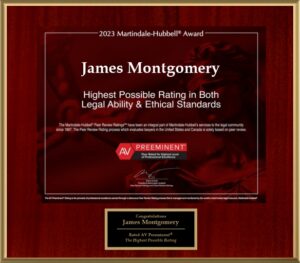
Lawyer peers have granted Mr. Montgomery a rating of “AV” which is Martindale Hubbell’s (rating agency) highest peer rating for lawyers.

We have presented papers and spoken to audiences that range from service clubs to the State Bar of Texas Continuing Legal Education seminars.

Mr. Montgomery was recently named Individual Finalist, San Antonio Ethics In Business Award, 2009 by the San Antonio Business Journal.

MontgHiRes

James Montgomery, Attorney and Rotarian, Honored on the San Antonio Movers and Shaker Show, June 28, 2008

James and Linda Montgomery are honored as the Featured Guests on the San Antonio Movers and Shakers Show June 28, 2008 by John Thurman of Heart of Texas Realtyhttp://www.heartoftexasrealty.com/ and Bjorn, Just Bjorn, of Bjorn’s Home Entertainment http://www.bjorns.com/
Jim was recently nominated for the Ethics in Business (EIB) Award of the CPA Ethics Squad. Mr. Montgomery was nominated for this award by Mr. John Thurman who is associated with Mr. Montgomery through the San Antonio Rotary Club at the Dominion. Mr. Thurman describes him as a “straight-up person” who is very honest and what you see is what you get.
His work with the Rotary Club has spanned many years and he is currently the Rotary International District Governor for the organization, which is a volunteer position that requires a full-time commitment. He travels regularly to local clubs in his district, which includes forty-four counties in south central Texas and nearly 3,000 Rotarians, in support of this organization and is committed to the pursuit of excellence.
His personal vision statement and goals are summarized in the Rotary 4 Way Test which is comprised of four questions which are 1) is it the truth, 2) is it fair to all concerned, 3) will it build goodwill and better friendships, and 4) will it be beneficial to all concerned? By being able to affirmatively answer these questions in every endeavor he pursues he is able to provide an example that others in business and the community admire and respect.
Mr. Montgomery is happy to work behind the scenes and is not interested in personal glorification. Sherri Muniz commented that “just prior to him assuming the duties of leading Rotary District 5840 there were some goals the prior leader had not yet realized, although they were nearly finished. Mr. Montgomery could have waited for the change of leadership, finished the jobs, and received the credit for the accomplishments. Instead, I received a private email asking for my assistance in moving the tasks along so that they would be finished under the leadership of the predecessor. I was impressed by this action; it was the correct and ethical action to take, yet no one else knew that Mr. Montgomery had acted in this way. His concern was not for himself, but for the dignity and achievement of those before him.” Another Rotarian, Rebecca Notzon, stated there is a quote by John C. Maxwell that describes Mr. Montgomery and it is, “A leader is one who knows the way, goes the way, and shows the way.” Rebecca went on to say “Jim shows leadership qualities by demonstrating integrity, creating vision, motivating people and leading by example.”
Mr. Montgomery became active in the Boy Scouts as a child, with his father being the Scout Master for his sons. His father provided an excellent example of high standards and values and those principles provided the foundation for Mr. Montgomery, Jr. to build his own personal value set. He has served as an Assistant Scout Master, Cub Master, and District Chairman for his own son carrying on the family tradition. Mr. Montgomery Sr., Mr. Montgomery Jr., and “Jimmy” (III) as he was called to keep the three Jim’s straight for the family members were all Eagle Scouts. “That is just unheard of,” exclaimed Sid Trawick who has been a friend of the family for years.
Mr. Montgomery (the Jr.) and his brother obtained the rank of Eagle Scout with the Boy Scouts of America under the superb leadership of his father, affectionately known as Mr. Monty by all the members of Troop 88. This is the highest rank attainable within this organization, it is held for life, and only about five percent of the Boy Scouts actually obtain this award. The requirements for this designation are rigorous and include earning at least twenty-one merit badges and demonstrating scout spirit, service and leadership. Although this achievement is difficult to obtain, it is easy to identify the individuals who have reached this goal because the recipients display the rank on their uniform by wearing a special metal, badge and rope.
Texas Supreme Court Justice Paul W. Green was very fond of Mr. Monty. He described him as a “bear of a man” that was well loved by all the boys. He could picture Mr. Monty presenting him with his Tenderfoot Badge all those years ago. He said, “Boys can sometimes get out of hand, but it was well understood that he was an authority figure and when he got irritated we snapped to and shaped up.” Both Justice Green and Roy Huff, III, another individual that made Eagle Scout under Mr. Monty, described him as a father figure. Mr. Huff stated, “He was a second father to me.” Justice Green said, “We all looked forward to the camp outs. No one ever wanted to disappoint him and failure was not an option. He made you feel proud of yourself because you accomplished your goals and achieved another badge. He was an inspiring man and we wanted to do it for him.” Justice Green commented that even today when people find out he is an Eagle Scout they are impressed because it is so hard to get. He attributes it to the love and support of Mr. Monty.
Mr. Monty ran the Eagle Scout Association here in San Antonio. He had an office and a computer and Sid Trawick described him as a “great man.” Mr. Trawick said when Mr. Monty was seventy years old he helped put the singles on the roof at Camp McGimsey, which is an indoor Boy Scout facility in San Antonio. He was also very skilled in working with wood and made excellent wood doll houses, which he donated to the Alamo Heights Rotary Club for fundraisers. Mr. Trawick said he wanted one of those for his daughter but was never able to win one. Someone always would end up bidding higher and win it, but he tied every time in hopes that he would succeed in winning that prize.
Mr. Montgomery’s mother, Vivian, worked at St. Luke’s Episcopal Church for quite a few years, according to Reverend Prehn, and at one point was the librarian there. Mr. Trawick knew her and said she loved her boys and the grandkids. She is remembered by Mr. Trawick as being a “behind the scenes” kind of mom who “stayed at home, took care of the kids and made sure dinner was ready when her husband came home.” That was the typical role for moms to have and they provided the support and foundation for the family so it could flourish.
He and his wife, Linda, are alumni scholarship contributors at the University of Texas at San Antonio (UTSA) and have had a named scholar for the last seven years. He is also a member of the Chancellors Council for the University of Texas System.
Linda describes her husband as an uplifting and inspirational speaker and stated that he is truly the wind beneath her wings. It was through his encouragement to go out of her comfort zone that gave her the confidence to become the President of the Alumni Association at UTSA. They have a blended family of four children with three daughters and a son. They have four grandchildren, three boys and a girl.Mr. Montgomery is very involved in various community fund raising activities. This includes being named the Chairman for the following fund raising activities: Cattle Barons Gala Live Auction, KLRN Wine Auction, Golden Gloves Regional Tournament from 1995-1997, and the March of Dimes Celebrity Serve Luncheon. He has sat on the Board of Directors for the San Antonio Youth Literacy and Leadership council, and is a member of the National Excalibur Society and the American Cancer Society.
He and his wife, Linda, are alumni scholarship contributors at the University of Texas at San Antonio (UTSA) and have had a named scholar for the last seven years. He is also a member of the Chancellors Council for the University of Texas System.
Linda describes her husband as an uplifting and inspirational speaker and stated that he is truly the wind beneath her wings. It was through his encouragement to go out of her comfort zone that gave her the confidence to become the President of the Alumni Association at UTSA. They have a blended family of four children with three daughters and a son. They have four grandchildren, three boys and a girl.
He and his wife own a house in Colorado and both love to ski. Sid Trawick has enjoyed many a ski vacation with them and describes them as a great couple.
Mr. Montgomery is a successful business owner. He owns and operates his own law practice James Montgomery Law. His honestly and integrity in and out of the courtroom has set him apart from the rest of his peers and he is known in the community for sticking to his high standards and value set.
It comes as no surprise that Mr. Montgomery is an AV-rated attorney, which is Martindale Hubbell’s highest peer rating for lawyers, and he has over 25 years of courtroom experience. He believes in self improvement and regularly attends continuing education classes to ensure he is providing exceptional guidance to his clients and opponents with his extensive knowledge and experience. His cliental began to request his expertise outside the courtroom to help them be proactive and prevent problems from occurring. This resulted in a shift of his business focus and he began providing consulting services for a wide range of services to include “the design of corporate structures and business transactions to increase profitability and minimize the amount of taxes paid by clients. His business advice programs are designed to maintain regular review and consultation in order to know the client’s business and plans in advance to maximize profit and minimize potential exposure.”
Mr. Montgomery lives by his ethical and moral values at home and in business and is not the type of person who deviates from those core values in different settings or environments. His personal mission statement is to do a good turn daily and service above self, the later being a core value of the Rotary Club, too.
Eagle Scouts are held to a higher standard and as Jim’s dad has stated, “When people find out you are an Eagle Scout they expect more from you.” Thomas Robins, a good friend and business associate stated, “Jim is the ultimate embodiment of what it means to be an Eagle Scout. His moral compass is as much a part of him as one of his internal organs.”
Religious faith with its morals, values and teachings are an integral part of Mr. Montgomery. He attended parochial school at St. Luke’s Episcopal School through the sixth grade and said “My Eagle project was in the 1960s and we helped reorganize the library at St. Luke’s Episcopal Church.” The school was founded in 1947. The Alamo Heights church as it stands today was built in 1954, but unfortunately the library was destroyed by water some years ago. Although the damage to the library was extensive Jim’s project has never been forgotten.
The Mission Statement for St. Luke’s Episcopal School is St. Luke’s Episcopal School is a Christian community dedicated to academic and personal excellence, lifelong learning, and service to others. The short phrase in that mission statement that is synonymous with Mr. Montgomery is ‘service to others,’ and he learned that lesson well at an early age. The school develops and encourages critical thinking, while instilling in the students a sense of responsibility, self discipline and respect. The reasoning behind this is “To be a citizen who contributes, one must not only have knowledge of mathematics and literature, but also knowledge of cooperation, sound judgment and leadership.[1]
Linda Montgomery has many kind words to say about her husband. She thinks Jim got his inspiration from his father and she was sorry she only got to spend fifteen years getting to know Mr. Monty. She said, “Jim won’t undermine someone, instead he knows how to encourage people and make them feel appreciated.” He has an uplifting affect on her and through encouragement has enabled her to “step outside of my comfort zone” and accept and conquer challenges like becoming President of the UTSA Alumni Association.
Richard Berchin described Mr. Montgomery as a “great role model.” His wife, Linda, agrees with that statement as does Stephanie Macchia, a business associate and Rotarian who stated, “He leads by example and because of this, people want to be like him.” Rebecca Notzon commented Jim always took actions based on an essential fairness to all concerned. She went on to say he always weighs the potential impact of his decisions and has treated equally all persons that are affected. He conducts his private and social life by preserving and protecting the positive image he portrays.
John Thurman stated, “Jim’s life, in the office and outside it, is synonymous with ethics of the highest caliber. He is an extremely successful businessman, but it is when you understand what he does with this success and expertise that you understand his high standard of ethics. After serving businesses in the courtroom for 25 years as a successful lawyer, Jim now dedicates his time to helping clients stay OUT of the courtroom. He counsels businesses in all aspects of structuring business agreements, represents buyers and sellers of businesses ranging from multi-million dollar office buildings to small pest control businesses, and advises and participates with real estate investors on income producing property and raw land investments. With this holistic approach, Montgomery fills the shoes of an in-house COO and legal counsel for a firm, for a fraction of the cost of a full-time employee, and certainly a small percentage of the cost of going to court. Throughout every transaction, here is his MO:
1) Constantly educates himself regarding new business trends to help his clients
2) Thinks more about his clients’ welfare than his bottom line
3) Always encourages those who work for him or with him by emphasizing their strengths
4) Mentors other attorneys in the business ways of the practice of law
5) Is a conduit for referring business among his clients whenever possible
6) Gets to know his clients so that when an opportunity comes along to refer business among his clients he does it
7) Strives to see that his business clients are given every possibility to become successful
8) Really wants to see his clients succeed
9) Makes time for his children and his grandchildren
10) Plans family trips so his children, stepchildren and grandkids can enjoy their extended family”
Mr. Montgomery stated he does not have followers he has equals and co-workers. During the interview process all respondents had similar responses that Mr. Montgomery was “not a dictator,” or “not out for personal glorification.” The common theme from the questionnaire participants was he leads through example and if he thinks the reason for doing something is worthwhile and/or productive he will encourage two-way communication in explaining the importance of the given project. Mr. James E. Watson, Executive Director of the Boys & Girls Clubs of San Antonio stated, “He uses a stimulating questioning technique to insure issues are well thought through and addressed in a creative manner.” He then convinces his co-workers that the project will benefit many people less fortunate than themselves, which creates a sense of pride, accomplishment, and self-worth in the completion of the task. The common response from the questionnaire participants on how he fosters two-way communication is that he is a good listener. Mrs. Sherri Muniz stated, “Mr. Montgomery is a leader in that he sets clear goals for those working on his leadership team. He is an inspiring leader; he is quick to give support and recognition to those who are working under him.” Janet Livingston commented that, “Jim is more of an ‘inspirer’ type of guy. He does not dictate to get the job done. He is regarded as smart, compassionate, hard-working, and positive and I think he has a great sense of humor!” Mr. Watson went on further to state that Mr. Montgomery’s reputation in the community was “Rock Solid,” and that he illustrates his character traits by making “sound decisions and by his actions.”
Thomas Robins, a good friend and former business associate stated, “While we were members of the same law firm, I watched Jim mentor younger lawyers in the ethical practice of the law. Jim turned down lucrative legal work when he felt he could not ethically represent certain clients. On at least one occasion, he did this over the objections of senior partners in the firm. Since we have been solo practioners, I have referred many litigation matters to Jim. He may not have won every case, but his clients always felt that they were well represented and treated with dignity and respect for a fair fee. Believe me I can’t say that about any other lawyer to whom I have referred cases. Jim has helped several of my referral clients, knowing that the work would be pro bono. He treats these clients in exactly the same professional manner that he treats the paying ones.”
Not only does he treat his clients in an upstanding professional manner, but he treats every one of his employees with the same respect. As Ms. Llewellyn says, “If it is important to me, Jim makes it important to him.” He continually encourages open communication and thereby makes the staff feel comfortable enough that they can address any issue or subject with him. He is open on all levels to new ideas, and trusts his employees’ judgment, because without effective communication there is no continual improvement.
Mr. Montgomery is also particularly keen in identifying the potential of individuals, his co-workers, and organizations. He helps support this by motivating them to recognize this quality within themselves. Ms. Llewellyn attests that, “He certainly has encouraged me to recognize that potential within myself and purposefully assigns me projects that foster that potential; specifically in areas I have expressed interest in, such as marketing.” Mr. Montgomery would never ask anyone to perform a duty that he was not willing to do himself. He sets his professional and personal goals high in an effort to inspire others do the same. He is a trustworthy and hard working individual who encourages the people around him to embrace these same qualities, not because it is their ethical obligation, but because he strongly deems these qualities to be important. He believes that most people are honest and hard working, or have the potential to achieve these principles, if only given the opportunity.
Submitted by John Thurman www.HeartofTexasRealty.com